May 1, 2014

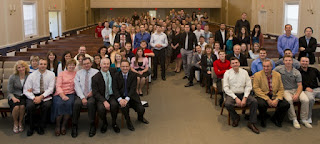
Baltimore pastors seeking fresh ways to engage the whole mission force in living life on mission

BALTIMORE, Md -- May, 2014: With hundreds of identified districts, Baltimore is called "a city of neighborhoods" where the metro area has grown to over 2.7 mill being the 20th largest in the U.S. Rich in history, Baltimore is where Francis Scott Key wrote "The Star-Spangled Banner", a poem recounting the British attacking during the 1812 war which became the official national anthem of the United States. God is doing an incredible work in the city where many local pastors and church planters have landed establishing new congregations reaching out to people that made Baltimore metro area their home. A diverse city, over 50 pastors and church planters came together on 1 May, 2014 for a time of prayer and fellowship seeking together fresh ways of engaging the whole mission force in living their life on mission. It was said that if we were to make an impact we need to mobilize the whole mission force, our people in our churches to live their life on mission making disciples where they live work and play. We need to de-professionalize missions if we were to see our communities and our cities transformed. The gospel is still the power of God unto salvation but the message needs to be heard from real people with genuine interest in the wellbeing of their friends, neighbors and communities. Hosted by The Gallery Church of Baltimore, the gathering proved to be a needed reminder that together we can do more that by ourselves. Many pastors serve the city alongside Ellis Prince, the host of the gathering and Ron Larson who's leading the church planting effort in Baltimore though Send Baltimore, the city's expression of the North American Mission Board's Send North America Strategy. Kevin Marsico, a local church planter pastor and NAMB's Northeast regional leader welcomed the pastors and updated the progress of church planting efforts in the region. For additional information about how you and your church can get involved in the city contact Ron Larson at rlarson@namb.net 
---
Mark Hobafcovich serves as mobilization and networking specialist at NAMB. Contact: mhobafcovich@namb.net; @JohnMarkGkobal 

Apr 22, 2014

PHILADELPHIA PA THE CITY OF "FIRSTS"

Pastors in Philadelphia Pa praying for spiritual awakening and revival
Philadelphia Pa -- April 22, 2014: Most Americans have heard of the historical importance of the city of Philadelphia in shaping up what will become the greatest democracy in the world, the United States of America. Philly has served as the first capital of the US for nearly a decade and set the precedent for government, religion and culture in the country. Philadelphia claims the title the “City of Firsts” for different achievements such as the first hospital in America and the first municipal water system.(1) There is a great sense of pride in the city for its past accomplishments and the future potential to lead the rest of the nation in a significant movement towards impacting  the rest of the country. Based on the experience of the over 100 pastors and leaders who gathered together on April 22, 2014 to pray, lift up the name of Jesus Christ and to look with fresh eyes at the mission field that is the city, we venture to say that the city of Philadelphia could once again prove itself to be "first" in spiritual awakening in the city and revival among the people of God, revival which could translate into a great movement of God's people becoming involved in the mission of God understanding that their "Life on Mission Matters" and making disciples where they live, work and play will be a priority. Faithful men like pastor K. Marshall Williams Sr have been serving the Lord for many years and as the host for this gathering of pastors is seeing the fruit of his labor where many young leaders present being the result of his 30 years of ministry at Nazarene Baptist Church and the prayer ministry that's been going on for many years is seeing results. Many dedicated men serve the city alongside Barry Whitworth who's leading the church planting effort in Philadelphia though Send Philadelphia, the city's expression of the North American Mission Board's Send North America Strategy. For additional information about how you and your church can get involved in the city contact Barry Whitworth at bwhitworth@namb.net
---
---
Mark Hobafcovich serves as mobilization and networking specialist at NAMB. Contact: mhobafcovich@namb.net; @JohnMarkGlobal

Jul 23, 2013

Towards Reaching the Deaf People in North America

BOLIVAR, MISSOURI -- Cars and church vans arriving on the campus of Southwest Baptist University in Bolivar, Missouri was a scene that may seem ordinary at first but this one was special as I've witnessed this week at the Southern Baptist Conference of the Deaf - 65th Anniversary where close to 300 people came to celebrate God's goodness for the many years of ministry and to discuss ways of reaching the lost as articulated in the mission statement that is guiding the SBCD "To reach Deaf persons for Jesus Christ by serving as a cooperative network  for Southern Baptist churches and agencies to fulfill the Great Commission by providing training, advocacy, worship, missions awareness and mission involvement. SBU, a university affiliated with Missouri Baptist Convention, the host for two years in a row proved to be a central and accessible place as evidenced by the diversity of number plates on the cars and vans in the parking lot. What would it take to reachout to more than 2 million deaf and 15 million hard of hearing people in the United States? 
This question was asked in sessions and workshops provided at the conference. The common answer seemed to be "training". Not just any kind of training but church based, since the church is God's agent of transformation as heralded by pastor Aric Randolph the newly called pastor of Brentwood Baptist Church Deaf Church in greater Nashville Tenn area who intends to train church planters and missionaries in his church. 
John lovas pastor of New Orleans Deaf Church informed the participants that he is using the acronym "BETS" in his attempt to have a balanced approach of church ministry. (Bring them in; Encourage them; Train them; and Send them out). Since the church is God's agent of transformation, training the local church is also a high priority so exploring ways of providing "Churches Planting Churches Training" to Deaf church pastors is also a priority where local churches are exposed to the process of multiplying themselves through church planting. 
There are over 50 Deaf churches who are part of the Southern Baptist Convention and the potential of doubling that number is a few short years is very high if each pastor will "train" another leader in his church and in partnership with other churches, Baptist associations, Baptist State Conventions, and the North American Mission Board will deploy that leader  into church planing ministry. In a very few years the number of churches will increase and many people will be reached with the Gospel of Christ. Working together is key. Lets work together for the glory of God and the good of the people!

---//---
Mark Hobafcovich, North American Mission Board of the Southern Baptist Convention. The North American Mission Board is the domestic mission agency of SBC with mission responsibility in the United States and Canada with headquarters in Alpharetta (Atlanta), Georgia. Mark can be reached at: email: mhobafcovich@namb.net; twitter: @JohnMarkGlobal

Apr 26, 2013

Exploring Ways of Reaching the Over 1.5 Million Ethnic Hungarians in North America

RAMA, ONTARIO, CANADA (about 100 miles North of Toronto) -- Names like the famous newspaper publisher Joseph Pulitzer (prize), socialite/actress Zsa Zsa Gabor and a host of others are well known throughout the world and they all have in common an Hungarian heritage. From the first known Hungarian immigrant to permanently settle in the United States in 1840 to the latest arrival of young professionals, they all have in common the quest for significance and purpose, either they acknowledge it or not. In obedience to the call of God on their lives and with these people in mind and a loving heart for the lost, Hungarian pastors gathered together at the Hungarian Baptist Camping grounds in Rama, Ontario to pray together and to seek ways of engaging the lost with the love and the gospel of Christ, exploring ways of reaching the over 1.5 million ethnic Hungarian people in the United States and Canada. Present were pastors Sandor Kulcsar traveling from the west coast of Canada, from Kelowna BC delighting the fellowship with his patriarchal spirit and a wealth of wisdom and experience. Also present was pastor Joseph Novak from the Los Angeles area leading us in deep contemplative devotions and meditation. With a tender heart and a sensitive spirit pastor Janos Lukacs from Cicago, Illinois led us in a very special devotion and transparent prayer time as well as pastor Geza Herjeczki from Detroit, Michigan who serves as president of the Hungarian Baptist Convention. It was a blessing to reconnect with pastor Istvan Gergely from the Hungarian church in New York City who shared with us that just a week prior he baptized two people as an indication of their obedience to follow Christ. A delight was also pastor Daniel Pusok of the Hungarian church in Toronto, Ontario, the host of the conference since the meeting was held on the grounds of the camp belonging to their church. His abilities as a great organizer and his wisdom beyond his years gives us all a sense that the future of the Hungarian work in North America rests on well prepared and able men of God and leaders that have a serving heart and a total dedication to the cause of Christ. Pastor Atilla Kulcsar, the newest servant among the Hungarian leaders came from Louisville, Kentucky where he lived with his wife and childers for the last few years attending the Southern Baptist Theological Seminary preparing himself for ministry and on the eve of their move to the west coast of Florida, planning to start a church in Sarasota where there is a large Hungarian community. We have prayed together, studied the Word together as well as providing a dialogue on the future of the Hungarian work exploring ways of engagement with the community for kingdom expansion. Challenges are many but also the possibilities abound. It's a matter of whether we as leaders are willing to pay the price by denying ourselves and investing in developing leaders so our efforts will be multiplied. The words of the Lord Jesus "Pray to the Lord of the harvest to bring forth laborers" resonated loud in our minds as we discussed challenges and explored possibilities. After a brief historical overview of the work, we were shifting our focus on the realities of the mission field, trying to understand what is our mission field with all its demographic shifts from the "forty-eighters" immigration wave in the middle of the 19th century to the "fifty-sixers" immigration wave in the middle of the 20th century to today's influx of young professionals who are more economic immigrants that their predecessors' ideological reasons of resettlement. We concluded that without the proper understanding of the mission field it will be impossible to have effective strategies of reaching people with the gospel. The dialogue shifted to discussing the mission force focussing on who are the people that will be ale to engage the people with the gospel. The Holy Spirit who lives in all genuine believers is of the absolute necessity reminding us of the words of the Lord Jesus "without me you can do nothing". Pastors and leaders from our existing churches are also of a great importance as well as other believers at large from "God's Church". We also concluded that other networks, associations and conventions are of a great importance in the work of the kingdom. We have to learn from one another for "iron sharpens iron" and "together we can do more than we can do by ourselves". Each pastor was challenged to "look with fresh eyes" in their congregation for leaders and "potential leaders" and to be intentional about developing them through discipleship and leadership development. The emphasis should not be focused on "knowledge" but on "obedience" as it is clearly stated in the Great Commission passage of Matthew 28:20 "and teach them to OBEY all that I have commanded you". In conclusion each pastor engaged in discovering existing leaders and potential leaders from among the Hungarian community in North America mentioning names of leaders who will be challenged to consider joining forces in reaching out to the Hungarian community with the gospel. A list of cities with potential new work as well as a list of potential leaders to be developed. One of the conclusions was that communication among the existing pastors and leaders of the Hungarian churches should became a priority so leaders will be encouraged and the work will be strengthen. The fellowship was sweet and the time was precious. I'm looking forward to see what the Lord will do as we continue to work together to extend His Kingdom. 

---//---
Mark Hobafcovich, North American Mission Board of the Southern Baptist Convention. The North American Mission Board is the domestic mission agency of SBC with mission responsibility in the United States and Canada with headquarters in Alpharetta (Atlanta), Georgia. Mark can be reached at: email: mhobafcovich@namb.net; twitter: @JohnMarkGlobal

Oct 1, 2012

Slavic Mission Forum, Washington DC Sept 29-29, 2012


The movement is growing and the impact is felt. Participants from as far as Boston, Florida, California, New York and everywhere in between.  Two days of mission focus and church planting discussions to reach out to Slavic (Eastern) Diaspora focusing on Russians, Ukrainians and Belarusians. Thanks to Victor Visotsky, the host pastor of New Life Russian Baptist Church in Falls Church Virginia, in Metro Washington DC area. 

Mar 31, 2012

Impact Europe 2012

Impact Europe trip starts in London, England; move on to Paris, France; Madrid, Spain; Rome, Italy; Tirana, Albania; Bucharest, Romania; and finish in Athens, Greece meeting with leaders in each city to dialogue and learn from each other for city impact. Also we will visit an orphanage Casa Dorca which was built in 1927 in Prilipet, western Romania and in 1950, the communists threw the children out of the orphanage and marched them down the street to the local authorities where they left them to fend for themselves. The children sang as they marched to the police station, “It’s so good to know we have a Father in heaven.”  After the fall of communism the property was returned to the original owners and about 30 children are cared for at Casa Dorca. We will meet with staff and minister to them and the children. 

Sep 29, 2011

The Two fundamental church planting approaches…

Much has been heard about church planting in the last few years. To most established church leaders, church planting seems to be a threat for the fear of “competition”. If understood correctly it shouldn’t be so. A simple definition of church planting can be such as “a process that results in a new church being established”. It should be distinguished from church development, where a new service is created that is integrated into an established congregation. For a church to be planted it must eventually have a separate life of its own and be able to function without its parent body, even if it continues to stay in relationship denominationally or network. There a basically two ways of approaching church planting. The fist and most popular is planting a church to evangelize a community or a people group. This is where most of the church planting literature is today. The other approach is evangelizing an area or a people group and as a result you plant a church. This seems to be more in line with the first century approach and if done correctly can bear much fruit with a lot less investment of resources. The first approach is depending much more on outside resources, human and financial, the second being more reliable on the willingness and sacrificial efforts of the missionary team. Both approaches can be beneficial to the kingdom of God. Employ whichever approach seems more appropriate to the mission field environment where you are for the glory of God.

Sep 25, 2011

Disciple Making -As followers of Christ Disciple Making ought to be our first preoccupation

The last commandment of the Lord Jesus Christ ought to be our first preoccupation as His followers. Making disciples of all peoples of the world is not only His commandment but also our privilege as His followers. Disciple making is a process that begins with God working in the lives of people everywhere, giving us "divine appointments" so we can engage people with the gospel message that has the power to transform people, making them "new creatures" through the miraculous transformation of the "new birth". Once born into the family, the process of maturing begins and obedience to Christ's commandments are a must to be able to become all that God wants us to become in Him. As a matter of fact, keeping His commandments is the proof of our love to Him. (John 14:15 --If you love Me, you will keep My commandments). Loving Him is serving Him. Serving Him is serving others. Serve somebody today and be involved in making disciples everywhere you encounter people. (Matthew 28:18-20)

Sep 22, 2011

U.S. percentage of “unchurched” is growing

George Barna is the founder of The Barna Group, a market research firm specializing in studying the religious beliefs and behavior of Americans, and the intersection of faith and culture. Barna is known for providing extensive surveys regarding Christianity and the state of the church. (Wikipedia). Barna’s new book on U.S. Christians, “Futurecast,” tracks changes from 1991 to 2011, in annual national survey. In 1991, 24 percent were “unchurched.” Today, it’s 37 percent. Whatever the church is doing is not working and Barna blames pastors for these findings. Read.

Sep 21, 2011

What’s in a name - The Southern Baptist Convention and the name change

The Southern Baptist Convention (SBC) is the world's largest Baptist denomination and the largest protestant body in the United States, with over 16 million members. It is also the second largest Christian body in the United States, after the Catholic Church. The word Southern in Southern Baptist Convention stems from its having been founded and rooted in the Southern United States. The SBC became a separate denomination in 1845 in Augusta, Georgia, following a regional split with northern Baptists over the issues of slavery (Wikipedia). Many years ago the debate about name change for the Southern Baptist Convention started with motions to study a name change having been presented to the convention on many occasions, such as 1965, 1974, 1983, 1989, 1990 and 1998. A straw poll on name change was defeated in 1999 as well as a 2004 motion to authorize the SBC president to appoint a group to study the name change. On September 21, 2011 the SBC president Bryant Wright announced a task force to study the prospect of changing the convention's name and sparked a lively debate during the SBC Executive Committee meeting in Nashville, Tenn. Read here.

Sep 11, 2011

Only in America!

The Chicago Daily Herald published a story about how a Japanese congregation rents space in a Korean church and has an office in a Romanian Church. It's a story that could only happen in America.
Read.

Jul 30, 2011

HIS KINGDOM vs. “my kingdom”-Lessons from Ottawa, Canada

One of the sad experiences that I’ve encountered in my 22 years of being a minister of the gospel is the way many pastors are very parish minded (there are many exceptions of course) meaning that no one can do anything ministry wise in “my city”, especially not starting other churches in the are area that “my church” is located. One of these exception is a church in Ottawa, the Canadian capital where they don't see another church plant in their city as a threat but they see it as a partner in reaching out to the area where there is a great need for the gospel witness. That’s encouraging to see that there are leaders with “HIS KINGDOM” perspective rather than “my kingdom” perspective. In your leadership role-“What kind of leader are you?”

Jul 21, 2011

Evangelistic Church planting the most effective way of reaching lost people

Evangelistic Church Planting is the most effective way of reaching lost people with the gospel. I'm saying "evangelistic" church planting just to emphasize the "reaching" aspect of church planting for not all church planting is evangelistic. You may have a group of people that decides to get together and start a new church without ever thinking about the "lost" person walking by the new place where the "new church" meets. The Lord Jesus came to "seek and save that which was lost" so in the spirit of the Lord Jesus we have to seek the lost just like He did. Someone said "What's worse than being lost?-No one looking for you!!" Think about that for a minute. Read the article on the state of church planting in the Southern Baptist Convention and beyond.

Jul 19, 2011

The End of Church Planting?

The End of Church Planting? A look at whether churches should expand through a missionary model rather than relying on professional entrepreneurial pastors to plant churches. This is the title of an article published not long ago. Read it here.

Feb 11, 2011

Mobilizing missionaries and churches for evangelistic church planting in the United States and Canada

The North American Mission Board has unveiled its national strategy called -Send North America- which will focus on mobilizing missionaries and churches for evangelistic church planting. Once churches or potential missionaries have connected with NAMB, after an assessment, NAMB will provide any needed equipping and training before the missionary or church enters the mission field. Evangelism and leadership development will be integrated throughout the process. “Sending” churches of all sizes that partner with NAMB will have a broad range of participation options, all the way up to and including starting a church themselves. If you would like your Baptist church to partner with NAMB to penetrate lostness in North America, please share some information so we can best assist you. This information will be used to help you with your next steps in this exciting journey. For registration, click the link.

Jan 21, 2011

Things working together for good

For the past few years, my wife Christine has been volunteering at a local ministry center working with women in crisis seeing hundreds of women in need come through the doors of the center outside Atlanta. Read about how a young woman has seen the blessings of allowing God to work things together for good to change her life. Read here.
--//--
Mark Hobafcovich - Church Planting Consultant, North American Mission Board, SBC. 

Dec 5, 2010

A new day for Albania

A small county in south estern Europe of less than 3.5 mil people, Albania had a very colorful history. After five hundred years of Ottoman domination, an independent Albania was proclaimed in 1912. The Communists took control of Albania after World War II and persecuted and suppressed religious observance and institutions and entirely banned religion to the point where Albania was officially declared to be the world's first atheist state. Religious freedom has returned to Albania since the regime's change in 1992. In November 2010 Albania granted legal status to over 135 evangelical churches in the country. It's a new day for Albania. Read about it at Impact Global.
--//--
Mark Hobafcovich - Church Planting Consultant, North American Mission Board, SBC.

Nov 3, 2010

Planting Churches "is a God thing"

It is well known that nothing worthwhile comes easy. This is even more true when you're talking about the work of the kingdom, particularly church planting. Planting churches "is a God thing". Why? A disciple making community is established in an area or group of people that previously had no gospel witness. That's something "out of nothing". Ex Nihilo--Only God can do that! However, planting churches demands hard work and sacrifice as experienced by Samantha Keller, a pastor's wife who writes about the church planting experiences in a blog entitled "The Biggest Surprises Of Church Planting". Read about her journey here. 
--//--
Mark Hobafcovich - Church Planting Consultant, North American Mission Board, SBC. 

Oct 28, 2010

Church Planting Initiative in Bay Area

San Francisco Bay Area, is an extensive, mostly urbanized region that primarily surrounds the San Francisco and San Pablo estuaries in Northern California with about 7.5 million people. It is home to many well-known cities and landmarks with San Francisco being the cultural and financial center of the area. It is internationally famous for its unique landmarks, steep hills, and history. It is also home to the Silicon Valley, the premier high technology region of the world which ranges from Redwood City in the north to San Jose in the south where many of the industry leaders in technology, including Google, Yahoo!, Cisco, Apple, Oracle, and Hewlett-Packard make their home. A group of missionaries and church planting strategists have developed an initiative of starting churches called 10-10-10 that will kick off a series of events in the Bay Area to launch a California-wide initiative with a goal of 40 new church starts. They are starting churches based on four models. The 'Antioch' priority, which is starting strong, strategically located, reproducing churches. The 'Athens' priority, planting churches among the least reached people groups, the 'Acts 2' priority which is starting small, reproducing indigenous churches that are usually bi-vocationally led and  'Amos' strategy which is aimed at starting churches around ministries of justice and community service. You can read about it at Baptist Press. 
--//--
Mark Hobafcovich - Church Planting Consultant, North American Mission Board, SBC. 

Oct 20, 2010

Reaching the foreign born in the United States-Almost 70 million people are first or second generation

The U.S. Census Bureau reports that 36.7 million of the nation's population (12 percent) were foreign-born, and another 33 million (11 percent) were native-born with at least one foreign-born parent in 2009, making one in five people either first or second generation U.S. residents to a total of almost 70 million people. What are the implications for sharing the gospel of the Lord Jesus Christ with the foreign born as well as their children and planting contextual communities of faith that will foster discipleship and mission mobilization remains the discussion of many mission groups. It's obvious that the foreign born population has different world view(s) that mainstream America and they need to be reached with contextual strategies. Befriend one person and share the gospel in a sensitive way expecting the Holy Spirit to do a miracle in their life. Read the original Census Bureau press release. 
--//--
Mark Hobafcovich - Church Planting Consultant, North American Mission Board, SBC.